Leading Minds 2026: 30 Years of Impact on Baltimore Schools and the Future of Public Education
February 20, 2026
February 20, 2026

President and CEO, Baltimore Curriculum Project
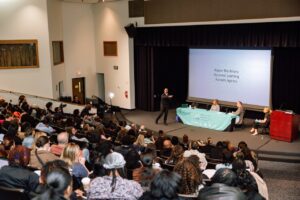
On February 6, 2026, Baltimore Curriculum Project (BCP) welcomed more than 300 educators, staff, partners, and education leaders to the annual BCP Leading Minds Symposium: Challenging Conversations in Public Education. For 18 years, we have been gathering as a BCP network of educators and leaders across our six neighborhood conversion charter schools to talk about pressing issues in public education. This year, though, felt especially meaningful as we celebrated 30 years of BCP and took time to reflect on how far we’ve come—and where we’re headed next.
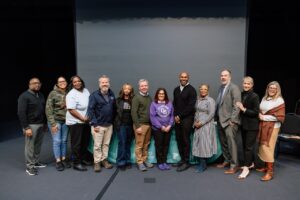 There’s something powerful about being in a room full of educators. The energy, the shared purpose, the willingness to learn from one another. It’s what makes days like Leading Minds so impactful. This year was no exception.
Setting the Context: Progress and Priorities in Baltimore City Public Schools
We kicked off the day with a thoughtful and engaging panel moderated by Alison Perkins-Cohen, Chief of Staff for Baltimore City Public Schools (City Schools), our educational partner since our founding in 1996. Alison brought both honesty and encouragement to the conversation.
She began by recognizing the work happening across BCP schools, sharing, “Baltimore Curriculum Project is such a special place—you really are the standard bearer for charter operators in the state.” It was a proud moment, but also a reminder of the responsibility we carry.
Alison then zoomed out to ground us in the broader context of Baltimore’s educational landscape. “You can’t understand where Baltimore City schools are today unless you go back further than 30 years,” she noted, pointing to decades of population shifts and funding inequities that continue to shape our work.
At the same time, she highlighted real progress under City Schools CEO Dr. Sonja Santelises: “Our graduation rates are up, literacy is up, math is improving, and enrollment increased for the first time in many years.”
One idea that really stayed with me was her reflection: “Having not enough, focuses the mind and forces you to prioritize what really matters.” That clarity is something all of us in education can relate to.
The Evolving Role of Philanthropy in Urban School Innovation
Roger Schulman, CEO of the Fund for Educational Excellence, added another layer by talking about philanthropy and what it can (and can’t) do. He grounded us in reality, explaining that while the district operates on a $1.7 billion budget, philanthropic funding is only about $7 million annually. And yet, those dollars can still make a difference if used well.
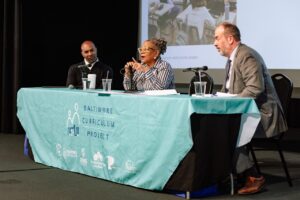
As Roger put it, “Philanthropy is not the primary driver of change, but it can be a powerful catalyst when aligned with clear priorities.” He reflected on how philanthropy’s relationship with the district has evolved over the past 30 years. Where funding once often bypassed the district, today there is much stronger alignment with district priorities—particularly under Dr. Santelises’s leadership.
He outlined three key ways philanthropy supports the district:
Looking ahead, Roger emphasized the importance of maintaining strong relationships, clarity of vision, and disciplined alignment, especially during leadership transitions. These are the conditions that allow philanthropy to truly support long-term impact.
Statewide Education Reform in Maryland: Literacy, Math, Accountability, and Teacher Investment
 Dr. Irma Johnson, board member of the Maryland State Board of Education, provided a valuable state-level perspective shaped by her 45-year career in education. She spoke about the increasing complexity of the work and the growing expectations placed on educators, while also grounding us in what matters most: strong instruction and support for teachers.
Dr. Johnson stated, “If you want to have smart children, you must have smart teachers.” Investing in educators, she emphasized, is essential to improving outcomes for students. She highlighted four major state initiatives:
At the same time, she spoke candidly about ongoing challenges, including funding constraints tied to the Blueprint for Maryland’s Future and the need to strengthen teacher recruitment pipelines.
AI in Public School Education: Technology, Equity, and Human-Centered Learning
 Ken Shelton, educational technology leader and co-author of The Promises and Perils of AI in Education: Ethics and Equity Have Entered The Chat, challenged us to zoom out even further to consider the national and global forces shaping education, particularly the rise of artificial intelligence AI). His message was both urgent and grounding: Technology does not improve learning, educators do.
In both the panel and his closing keynote, Ken pushed us to think beyond tools and focus on purpose. He reminded us that: “Behind every data point is a human story” and “Students can be present but not engaged.”
On AI, his message was clear: we cannot ignore it, and we should not fear it. Instead, we must teach students to engage with it critically and ethically. AI should support thinking—not replace it.
For educators, this means designing learning experiences where students:
At its core, Ken’s message reinforced something deeply familiar: Relationships remain the foundation of great teaching. Always have. Always will.
From BCP’s Leading Minds to Action in the Classroom: What’s Next for BCP and Baltimore Public Education?
Following the panel, our educators engaged in breakout sessions that brought these ideas into practice. They explored topics like Restorative Practices, attendance, literacy, school funding, and AI in the classroom.
These moments of collaboration are where the real magic happens at our Leading Minds events. It’s where big ideas become practical strategies, and where educators learn just as much from each other as they do from any speaker.
As I reflect on this year’s symposium, I am struck by both the progress we’ve made and the responsibility we carry forward. For 30 years, Baltimore Curriculum Project has remained committed to one core belief: every child deserves access to an excellent education. That belief continues to guide our work, and it is strengthened by the collective expertise, passion, and dedication of our educators.
Leading Minds wasn’t just a moment to reflect. It was a reminder of what’s possible when we stay grounded in our purpose and move forward together.
And honestly, I can’t wait to see what we do next.