Why School Attendance Matters for Student Achievement: Addressing Chronic Absenteeism in Baltimore Schools
August 25, 2026

August 25, 2026
At Baltimore Curriculum Project (BCP), we believe every child deserves the opportunity to succeed. That means ensuring every student has access to excellent instruction, caring adults, and a school community where they feel known, supported, and inspired.
But before any of that can happen, students have to be in school.
Over the past several years, chronic absenteeism has become one of the biggest challenges facing public education. Following the pandemic, attendance rates declined across the country and in Maryland. Baltimore has been among the communities hit hardest.
We knew that if we wanted to improve student achievement, attendance had to become one of our highest priorities.
BCP’s Transforming Attendance Initiative to Improve Attendance and Academic Achievement
Thanks to the generous support of the Abell Foundation and the Richman Foundation, BCP launched the Transforming Attendance Initiative across our six neighborhood charter schools. Our goal wasn’t simply to improve attendance for the more than 3,000 students we serve. We also wanted to develop practical, evidence-based strategies that could help other schools in Baltimore and beyond.
 Today, I’m excited to share what we learned during Year One of this work. Each of our schools made meaningful progress toward getting more students back into the classroom.
During Year One, BCP schools:
While we’re proud of these results, the numbers are only part of the story.
Download our free Improving Attendance, Improving Achievement: Transforming Attendance Initiative Year One Report.
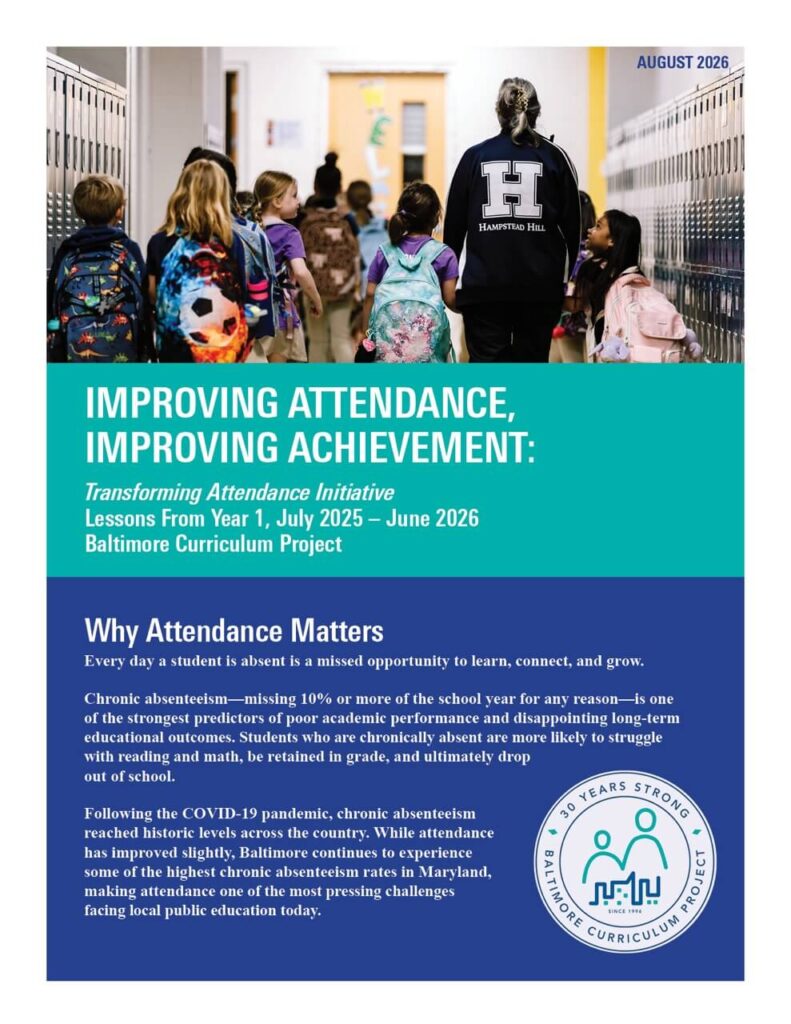
Click on the link or the image to download the report.
The Biggest Takeaway: Attendance Starts with Relationships
 The biggest lesson we learned is that improving attendance isn’t about enforcing rules. It’s about building relationships. When families know their school is a partner, when students feel connected to caring adults, and when schools identify attendance concerns early, students are much more likely to come to school consistently. That approach shaped everything we did during Year One.
Proven School Attendance Strategies That Work
Our schools identified several strategies that consistently helped improve attendance:
Every school is different. Every neighborhood is different. But these strategies proved that meaningful improvement is possible when schools proactively work alongside families instead of reacting to attendance problems.
Year Two Goals for Improving School Attendance
 Our work is just getting started. During Year Two of the initiative, we will continue building stronger attendance systems by:
We are grateful that the Richman Foundation has already committed funding to support Year Two of this important work.
Helping Schools Reduce Chronic Absenteeism
From the very beginning, our goal extended beyond BCP. We believe schools should learn from one another, and we hope the lessons from this initiative will help other educators and school communities tackle one of the most significant challenges facing schools today.
Read the Full Transforming Attendance Initiative Report
I invite you to read our Improving Attendance, Improving Achievement: Transforming Attendance Initiative Year One Report and explore the lessons, strategies, and stories behind this work.
We are sharing this report with Baltimore City Public Schools’ new CEO, leadership at the Maryland State Department of Education, policymakers, nonprofit partners, and educators across Maryland and the nation. We hope the strategies we’ve developed will spark conversations, inspire new ideas, and ultimately help more students attend school every day.
Please reach out to me at ldoherty@baltimorecp.org to suggest educators and leaders who might enjoy a PDF copy of the report.
Because every day a child is in school is another day filled with possibility. And every child deserves that opportunity.
