Whole-Child Learning Drives Student Success Across Baltimore Curriculum Project Schools
May 27, 2026

May 27, 2026

How Enrichment Connects to BCP’s Mission and the Community’s Needs
BCP’s mission of converting neighborhood schools in Baltimore’s underserved communities is to educate and serve a wide spectrum of needs in those neighborhoods, including after-school and summer programming.
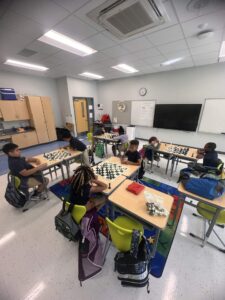 Govans Elementary’s Board Room Chess program, for example, meets several needs of families in the community. For the past four years, this community partner has led a popular Chess Club for Govans students.
Students enjoy learning how to play the classic game, the benefits of which are widely known. Studies show that chess improves critical thinking, logic, and pattern recognition. It helps children develop patience and focus and enhances decision-making skills.
From an emotional perspective, playing the game against friends and in tournaments, which is part of the Board Room Chess program, teaches sportsmanship, resilience, and how to win and lose with grace and empathy. Read more about the academic and social-emotional benefits.
“The Chess Club has become a fun and interactive space for students throughout the school year,” says Quentin Braswell, Govans’ Out of School Time Program Director. “As they learn more about the game, you see them not only become more confident in their matches but in other areas as well. It has been great to watch some students also become teachers themselves to assist their peers in understanding the game, different strategies, etc.”
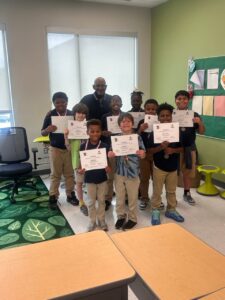 Coby, a 5th grade student who has been part of the Chess Club since 2nd grade, says the Govans Elementary chess program has helped me learn how to help others fix certain mistakes. While the team did not participate in a local tournament this school year, the team placed third at a Baltimore-wide tournament. His favorite aspect of tournaments? He says he likes meeting new people and seeing how they play.
Mr. Henry saw a similar transformation at Frederick Elementary when he introduced chess club as an afterschool program. As a boy, he never learned the game of chess and wanted FES students to have the opportunity to learn. What happened beyond the afterschool was amazing.
“The Chess Club students had rapid development in all aspects, academically, socially, and emotionally,” he recalls. “The lessons they learned and the confidence they developed from having success in the program (each year they ranked high among other school chess clubs) have a tremendous impact on them.”
Discover more about Board Room Chess and its partnership with BCP.
How BCP’s Afterschool Programs Support the Community Schools Model
BCP schools are nationally recognized as exceptional Community Schools Models. Afterschool enrichment programs are vital to this model, acting as a bridge to extend the school day to provide safe, supervised environments where students can thrive academically and personally.
Enrichment programming makes a crucial difference to the families in the underserved neighborhoods BCP serves:
One of BCP’s longtime community partners is Girls on the Run of Greater Chesapeake (GOTR). For over a decade, nearly every BCP school has had a GOTR chapter to empower girls to run, compete, and bolster confidence and resilience.
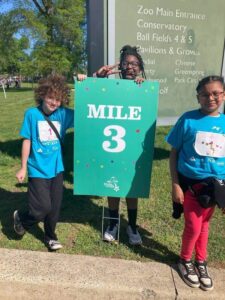 The GOTR team at Wolfe Street Academy is part of a robust athletics enrichment program that includes a coed baseball team that competes in the Southeast Baseball League, a coed soccer team, and coed disc golf.
Providing athletic enrichment for children in underserved communities is about equity. Low-income students are often priced out of today’s “pay-to-play” recreational sports programs. Public charter schools like Wolfe Street (and all BCP schools) that provide free athletics ensure that children from low-resource backgrounds are not excluded from physical activity and the critical developmental and academic opportunities they provide.
Participating in organized sports through school offers numerous benefits from improved mental health through stress reduction to cognitive engagement and improved focus, which translate directly to the classroom. They learn vital life skills like discipline, time management, and accountability. Fostering a lifelong enjoyment of physical activity is key to help prevent obesity and related chronic illnesses often found in underserved communities. Equally as important, children also practice emotional resilience in a safe, structured environment by learning how to process wins, losses, and setbacks.
How BCP Principals and Educators Choose Enrichment Activities
There is a great deal of intention that goes into selecting the right opportunities for specific groups of students like grade-level appropriate activities:
Sometimes, of course, the choice of activity is personal.
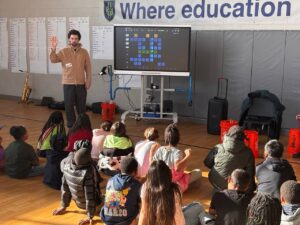 During Mr. Henry’s tenure as FES Principal, he introduced bucket drumming by a local artist to students who self-selected this option. A drummer himself from age 5, Mr. Henry appreciated the opportunity for students to learn about music and its proven effectiveness in deepening learning in core content areas.
“The performances students gave were also full of energy and excitement, and the students who participated showed greater interest in their academic content classes when they could directly relate an element of what they were learning in the drumming class to the subject matter of the class,” he recalls proudly.
Those students became leaders among their classes, an essential element of the FES purpose, and those leadership skills, confidence, and joy in experiencing new activities and being part of a close-knit group make all the difference as they move through their educational journey and through life.
Today, BCP schools enjoy drumming and other music enrichment through a unique community partnership with The Music Workshop. Read about this creative collaboration.
Through whole-child learning and an array of intentional enrichment offerings, BCP schools are helping students discover their strengths, build confidence, and develop the skills they need to thrive in school and in life. By investing in meaningful partnerships, responsive programming, and supportive school communities, BCP continues to create environments where every child is seen, supported, and empowered to thrive in school and in life.